
As spring approaches, Michigan begins enforcing frost law restrictions (also called seasonal weight restrictions) to protect roads during the thawing season. Roads can look perfectly fine on the surface — but underneath, the base becomes soft and unstable as frost thaws unevenly. That’s when heavy axle loads can cause serious damage fast.
Below is a clear breakdown of why Michigan enforces frost laws, when the 2026 restrictions start, what weight reductions apply in both state and county roads, and how it affects permits and routing.
Why Does Michigan Enforce Frost Laws?
During winter, the ground under the pavement freezes solid and supports heavy loads better. But when temperatures begin rising, the thaw happens from the top down — and moisture gets trapped between the warming pavement and the still-frozen layers underneath.
That trapped moisture softens the roadbed and makes it far more vulnerable to:
Cracking
Potholes
Surface breakup
Long-term structural damage
That’s why MDOT and local road agencies enforce seasonal restrictions every year during the spring thaw.
When Do Michigan Spring Weight Restrictions Start (2026)?
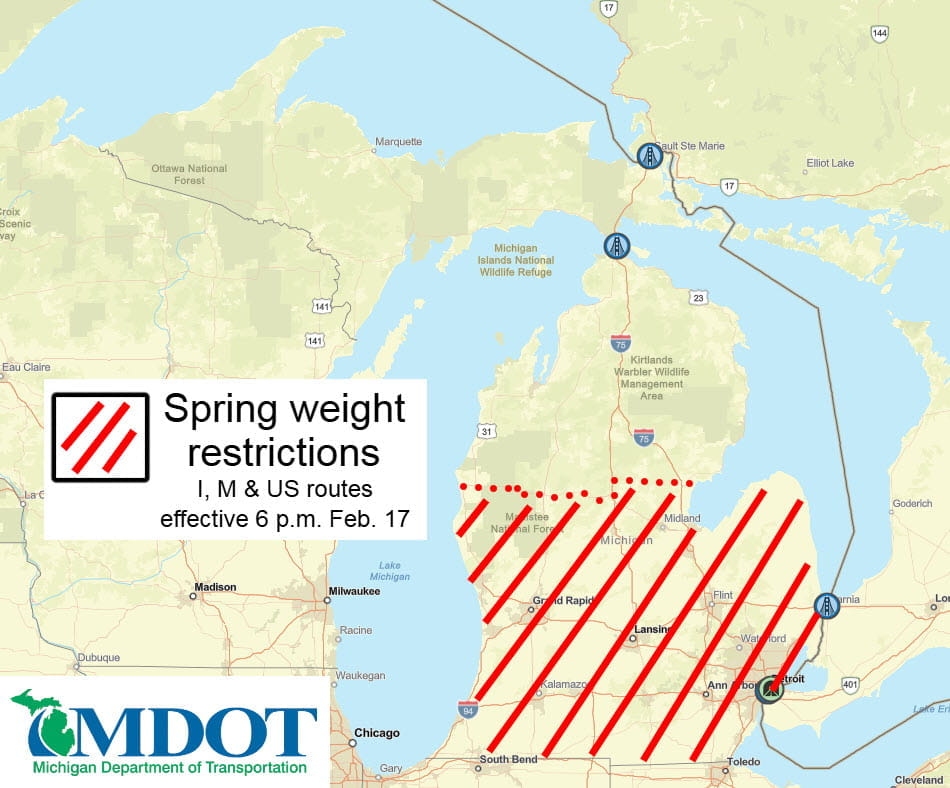
MDOT’s 2026 spring weight restrictions begin Tuesday, February 17, 2026 (effective 6:00 p.m.).
MDOT described the initial 2026 enforcement area as state trunkline highways from the Indiana and Ohio borders north to and including the following line:
US-10 in Ludington (from M-116) → east to US-127 (Clare County)
US-127 → north to M-61
M-61 → east to US-23 in Standish (Arenac County)
Important: Michigan’s restricted areas typically change as thaw conditions evolve — so the fastest way to stay current is to check the MDOT Truck Operators Map and restriction updates.
What “Affected Area” Means (Very Important)
Based on confirmation from Michigan:
Overweight loads are not allowed at all in the affected area.
In other words, overweight permits are not usable there during the restriction period (even if a route looks good on a map).Permits for loads exceeding 14 feet in width are typically not issued during this time to protect the road shoulders.
All state trunkline highways inside the affected area are under seasonal restrictions.
However, some roads have even tighter seasonal limits than others depending on road type (rigid vs flexible), which changes how much axle weight must be reduced.
Which State Roads Have “Standard” vs “More Restrictive” Limits?
Within the affected area, Michigan trunklines are commonly grouped into two practical categories:
1) Routes that stay at normal legal limits (often called “all-season”)
These roads are still inside the restriction area, but they do not require reduced legal axle weights (they remain at normal legal loading).
2) Routes that require reduced axle weights (often called “seasonal” routes)
These roads apply additional axle-weight reductions during the restriction period, based on road type:
Rigid (concrete) roads: 25% reduction
Flexible (asphalt) roads: 35% reduction
Some vehicles may also be subject to a 35 MPH maximum speed in restricted conditions.
These roads can be found on the Truck Operators Map (PDF): https://www.michigan.gov/mdot/
County Road Seasonal Restrictions (CRA Map)
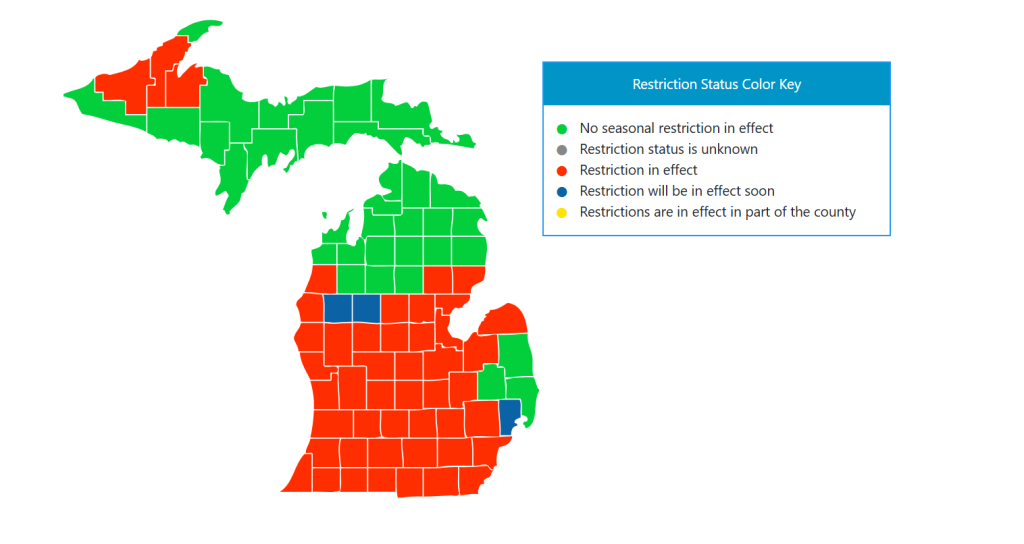
The map image above shows current county road seasonal weight restriction status across Michigan. It was last updated 02/18 at 7:58 AM CST (per the CRA map system).
⮞ Source: Michigan County Road Association (CRA) Seasonal Weight Restrictions Map: https://micountyroads.org/
Michigan Axle limits during spring restrictions
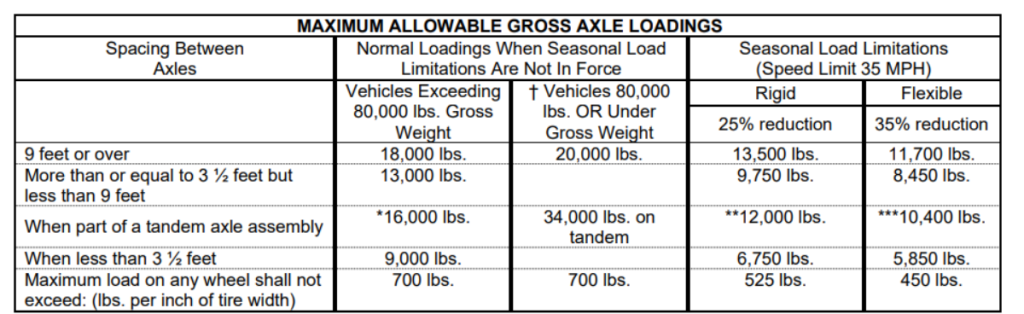
◈ Michigan Spring Restriction Period
During Michigan’s spring restriction period, allowable axle weights depend on:
Axle spacing
Type of roadway you’re on
The easiest way to think about it is:
1. Rigid Roads (Concrete / Concrete-Base)
Reduce normal legal axle limits by 25%
Multiply your normal limit by 0.75
Example: If your axle group is normally legal at: 18,000 lbs → 13,500 lbs on rigid (18,000 × 0.75)
2. Flexible Roads (Typically Asphalt)
Reduce normal legal axle limits by 35%
Multiply your normal limit by 0.65
Example: If your axle group is normally legal at: 18,000 lbs → 11,700 lbs on rigid (18,000 × 0.65)
◈ Tire Width Limits During Restrictions
Don’t just look at the axle limit; look at your tires. During restrictions, the road isn’t just weak—it’s brittle.
On Flexible (Asphalt) Roads: 450 lbs per inch of tire width.
On Rigid (Concrete) Roads: 525 lbs per inch of tire width.
Example: If you have 11-inch tires on an asphalt road: $11 \text{ inches} \times 450 \text{ lbs} = 4,950 \text{ lbs per wheel}$ (or 9,900 lbs for the axle). Even if the ‘legal’ frost limit is higher, the tire width rule will get you fined.
The following examples are shown as a guide for figuring the maximum allowable gross axle loads on all state trunk lines during all periods of the year. The maximum load on any wheel shall not exceed 700 lbs. per inch of tire width.
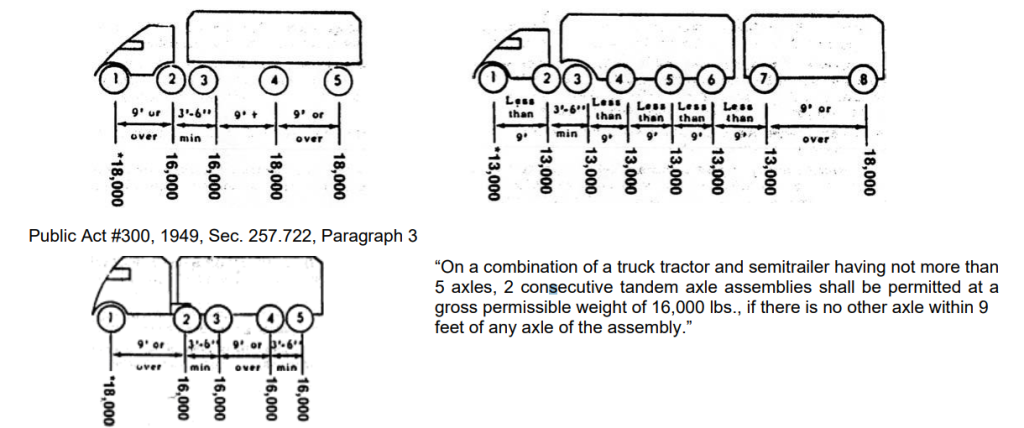
Steering Axle Weights
Can be the maximum of 18,000 lbs. (11,700 lbs. frost restrictions) if equipped with high pressure pneumatic or balloon tires (never to exceed 700 lbs. per inch of tire width).
Other Tandem Axles and Multi Axles
On any other combinations of vehicles exceeding a gross weight of 80,000 lbs., only one (1) tandem axle assembly shall be permitted at this weight (16,000 lbs. per axle). No other tandem axle assembly shall exceed 13,000 lbs. per axle.
Key Practices for Dispatchers and Drivers
Check restrictions the same day you dispatch (MDOT for state roads, CRA for county roads).
Assume “no overweight” in the affected area — overweight permits can’t be used there.
Verify axle group weights (steer / drives / trailer), not just gross.
Confirm the last-mile roads to the shipper/receiver (county roads can be tighter).
Follow posted speed limits/permit conditions in restricted areas.
Michigan frost restrictions change how loads move during the spring thaw. The biggest takeaways are simple:
In the affected area, overweight loads aren’t allowed.
Some roads have extra reductions on legal axle limits, depending on rigid vs flexible pavement.
If you want fewer surprises, verify restrictions early, check axle groups, and confirm county access. Synchron Permits can help you plan the safest route and compliance approach before you roll.